
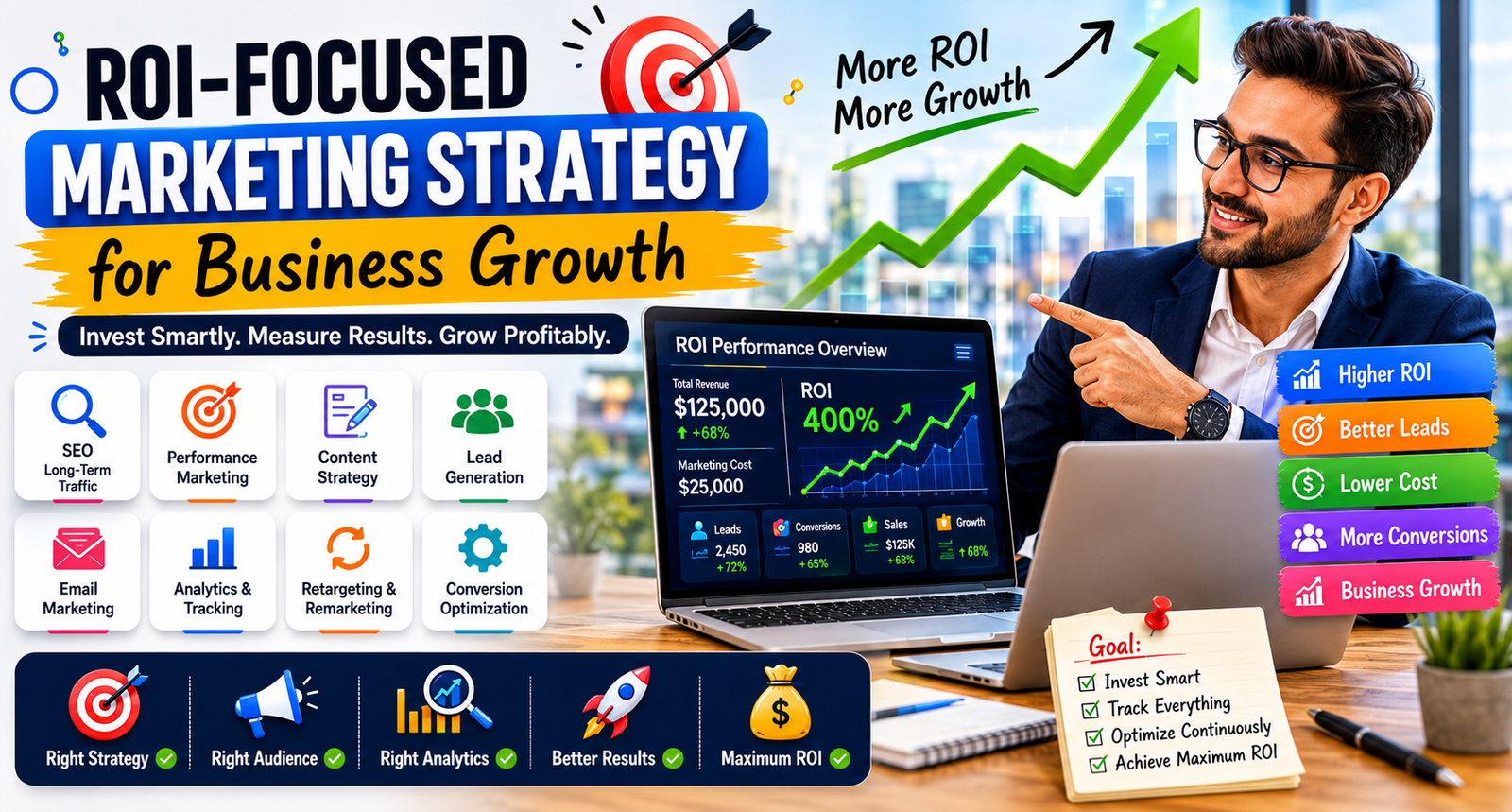
ROI-Focused Marketing Strategy for Business Growth
Learn how an ROI-focused marketing strategy helps businesses increase revenue, improve conversions, reduce costs, and achieve long-term growth.
ROI-focused marketing strategy has become one of the most important approaches for businesses in today’s competitive digital world. Companies no longer want marketing that only looks attractive — they want measurable results, higher conversions, increased revenue, and long-term business growth.
ROI (Return on Investment) helps businesses understand how much profit they are generating from their marketing efforts. Whether it is SEO, social media marketing, paid ads, or content marketing, every campaign should contribute toward business growth and profitability.
In this blog, we will explore how an ROI-focused marketing strategy works, why it matters, and the best techniques businesses can use to maximize growth and marketing performance.
What is an ROI-Focused Marketing Strategy?
Understanding ROI in Marketing
ROI in marketing measures the return generated from marketing investments.
Simple ROI Formula
ROI=Revenue−Marketing CostMarketing Cost×100ROI = \frac{Revenue - Marketing\ Cost}{Marketing\ Cost} \times 100
An ROI-focused marketing strategy ensures that every campaign is optimized to generate:
- More Leads
- Higher Sales
- Better Conversion Rates
- Increased Revenue
- Long-Term Customer Value
Businesses that focus on ROI make smarter marketing decisions and reduce unnecessary spending.
Why ROI-Focused Marketing Matters
Better Budget Utilization
An ROI-driven strategy helps businesses spend money on channels that actually deliver results.
Instead of wasting budget on ineffective campaigns, businesses can focus on:
- High-performing ads
- SEO strategies
- Conversion optimization
- Retargeting campaigns
This improves overall profitability.
Data-Driven Decision Making
Modern marketing relies heavily on data and analytics.
Businesses now track:
- Website Traffic
- Conversion Rates
- Cost Per Lead
- Customer Acquisition Cost
- Return on Ad Spend (ROAS)
These insights help marketers optimize campaigns continuously.
Key Components of an ROI-Focused Marketing Strategy
1. Clear Business Goals
Every successful marketing strategy starts with clear objectives.
Common Marketing Goals
- Lead Generation
- Brand Awareness
- Sales Growth
- Website Traffic
- Customer Retention
Without measurable goals, businesses cannot properly track ROI.
2. Understanding Target Audience
Knowing your audience improves marketing effectiveness.
Important Audience Factors
- Age Group
- Interests
- Buying Behavior
- Problems and Needs
- Online Platforms Used
Understanding customer intent increases conversion rates significantly.
SEO for Long-Term ROI
Search Engine Optimization (SEO)
SEO is one of the highest ROI-generating digital marketing strategies.
Search engines like Google reward websites with:
- Helpful Content
- Fast Performance
- User Experience
- Mobile Optimization
SEO helps businesses generate consistent organic traffic without depending completely on paid advertising.
Content Marketing for Business Growth
High-Quality Content Builds Trust
Content marketing helps businesses educate and engage audiences.
Effective Content Types
- Blogs
- Videos
- Social Media Content
- Case Studies
- Email Newsletters
Valuable content improves customer trust and increases conversions.
Focus on Problem-Solving Content
Content should answer customer questions and provide solutions.
Businesses that create helpful content improve:
- Search Rankings
- User Engagement
- Brand Authority
- Lead Generation
Performance Marketing Strategies
Paid Advertising for Fast Results
Performance marketing focuses on measurable outcomes.
Popular Platforms
- Google Ads
- Facebook Ads
- Instagram Ads
- LinkedIn Ads
- YouTube Ads
Performance marketing allows businesses to track every rupee spent.
Conversion Rate Optimization (CRO)
Improve Website Conversions
Generating traffic alone is not enough. Businesses must optimize websites for conversions.
CRO Techniques
- Clear CTA Buttons
- Faster Website Speed
- Mobile Optimization
- Better Landing Pages
- Trust Signals and Reviews
Small improvements in conversion rates can significantly increase ROI.
Social Media Marketing for ROI
Build Brand Awareness and Engagement
Social media platforms help businesses connect directly with audiences.
Platforms Include
- YouTube
Businesses use social media for:
- Content Distribution
- Lead Generation
- Community Building
- Brand Positioning
Consistent branding improves long-term growth.
Importance of Analytics and Tracking
Measure Everything
Analytics help businesses understand campaign performance.
Important Metrics
- Website Traffic
- Bounce Rate
- Conversion Rate
- Cost Per Lead
- Customer Lifetime Value
Tracking helps improve marketing decisions and maximize ROI.
AI and Modern Marketing Strategies
AI-Powered Marketing
Artificial Intelligence is transforming digital marketing rapidly.
Platforms like OpenAI help businesses automate:
- Content Ideas
- Customer Support
- Ad Optimization
- Audience Targeting
AI improves efficiency and marketing performance
Future of ROI-Focused Marketing
Data and AI Will Dominate
Future marketing strategies will rely more on:
- AI Automation
- Predictive Analytics
- Personalization
- User Intent
- Customer Experience
Businesses that adapt to modern marketing trends will achieve better long-term growth.
An ROI-focused marketing strategy helps businesses achieve sustainable growth by concentrating on measurable results, customer engagement, and conversion optimization. Modern marketing success is no longer based only on visibility — it depends on how effectively marketing efforts generate revenue and long-term business value.