
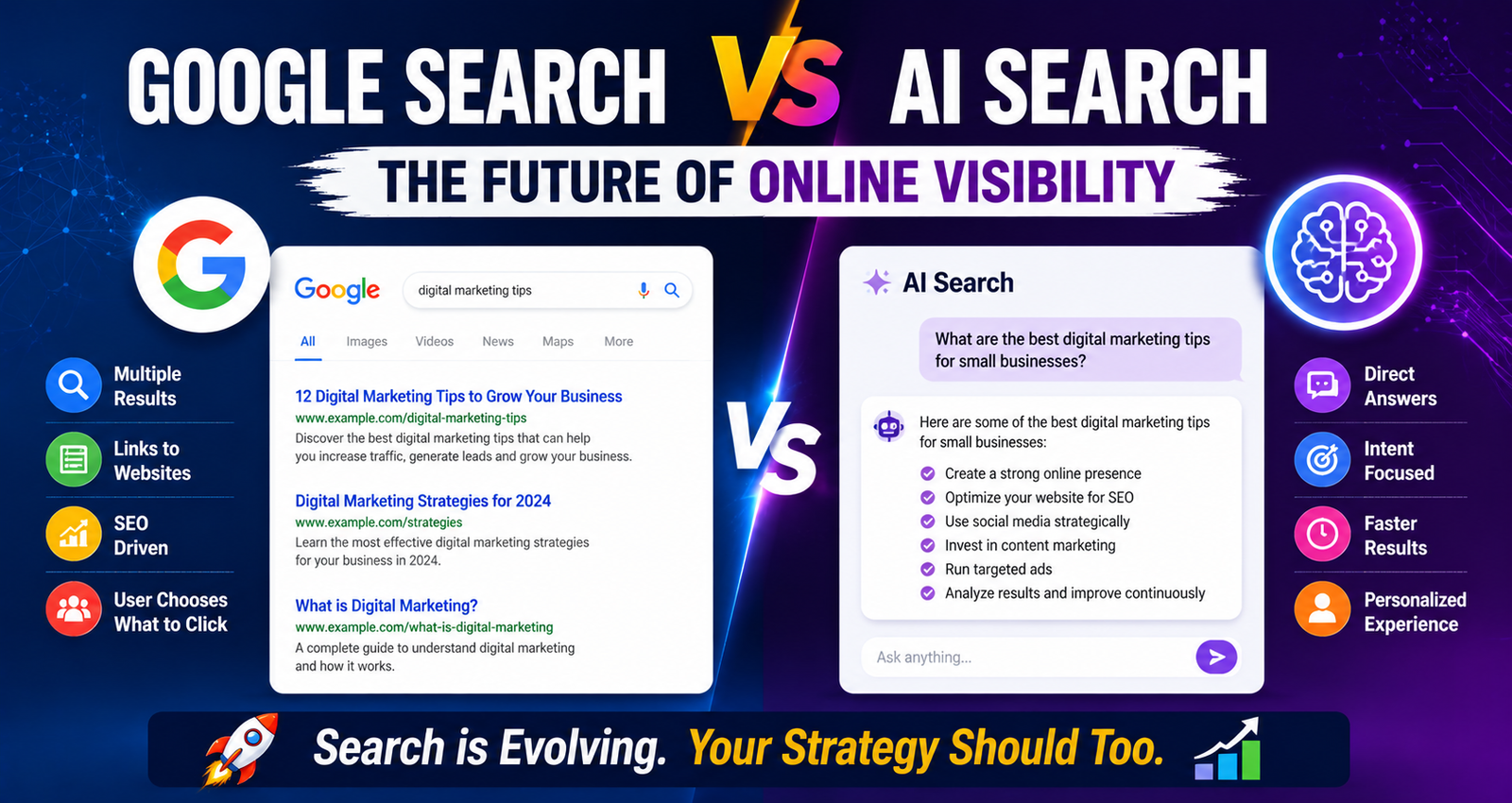
Google Search vs AI Search: The Future of Online Visibility
Learn the difference between Google Search and AI Search and discover how businesses can improve online visibility in the future of search.
Google Search vs AI Search: The Future of Online Visibility
Google Search vs AI Search is becoming one of the most discussed topics in digital marketing as search behavior continues to evolve. For years, Google Search has been the primary way users find information online. However, the rise of Artificial Intelligence (AI) has introduced a new way of searching, where users receive direct answers instead of browsing multiple websites.
With AI-powered platforms such as ChatGPT, Gemini, and Perplexity gaining popularity, businesses and marketers must understand how these technologies impact online visibility. In this blog, we will compare Google Search and AI Search, explore their differences, and discuss what the future holds for businesses looking to stay visible online.
What Is Google Search?
Google Search is a search engine that indexes billions of web pages and provides users with relevant results based on their search queries. Users type keywords into Google, and the search engine displays a list of websites that best match the query.
Key Features of Google Search
- Keyword-based ranking system
- Organic and paid search results
- Website indexing through crawlers
- SEO-driven visibility
- Local search capabilities
Google Search remains the world's most widely used search engine because it provides access to a vast amount of information from different sources.
What Is AI Search?
AI Search uses artificial intelligence and machine learning to understand user intent and provide direct, conversational answers. Instead of showing a list of websites, AI tools often generate a summarized response from multiple sources.
Key Features of AI Search
- Conversational responses
- Context-aware answers
- Natural language processing
- Personalized search experience
- Faster information retrieval
AI Search focuses on delivering immediate answers, reducing the need for users to visit multiple websites
Google Search vs AI Search: Major Differences
1. Search Results Format
Google Search
Google displays multiple web pages, allowing users to choose which source they want to visit.
AI Search
AI Search generates a direct answer, reducing the need to browse multiple websites.
2. User Experience
Google Search
Users compare information from various websites.
AI Search
Users receive summarized information instantly.
3. Website Traffic Impact
Google Search
Websites receive organic traffic when users click search results.
AI Search
Users may get answers directly, potentially reducing website visits.
4. SEO Requirements
Google Search
Traditional SEO focuses on keywords, backlinks, technical SEO, and content quality.
AI Search
Businesses need to optimize content for AI-generated answers and user intent.
How AI Search Is Changing Online Visibility
The rise of AI Search is transforming digital marketing strategies. Businesses can no longer rely solely on traditional SEO techniques. Content must now be structured in a way that AI systems can easily understand and reference.
Key Changes Include:
- Increased importance of high-quality content
- Focus on answering user questions directly
- Greater emphasis on authority and trustworthiness
- Need for structured data and schema markup
- Optimization for conversational queries
Companies that adapt to these changes will have a better chance of maintaining online visibility in the future.
Benefits of Google Search
Advantages
- Drives website traffic
- Supports local business discovery
- Provides multiple information sources
- Strong advertising opportunities
- Established ranking ecosystem
Benefits of AI Search
Advantages
- Faster answers
- Improved user experience
- Better understanding of complex questions
- Personalized interactions
- Efficient information retrieval
Which One Is Better for Businesses?
The answer is not Google Search or AI Search—it is both.
Businesses should focus on creating valuable content that performs well in traditional search engines while also being optimized for AI-generated responses.
A balanced strategy ensures maximum online visibility across different search platforms.
Future of Online Visibility
The future of online visibility will involve a combination of Google Search, AI Search, voice search, and personalized search experiences.
Businesses that invest in quality content, technical SEO, and AI optimization will be better positioned to attract customers and maintain a strong online presence.
The evolution of search technology presents new opportunities for brands willing to adapt and innovate.